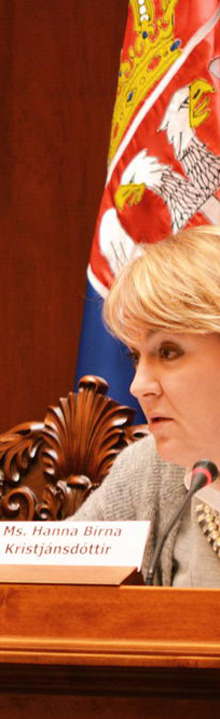


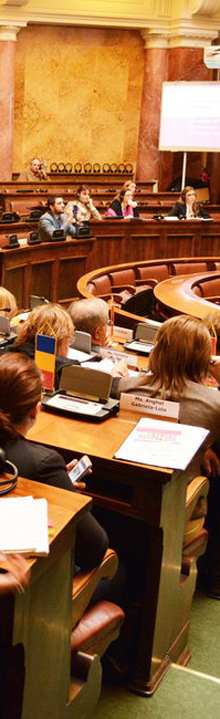

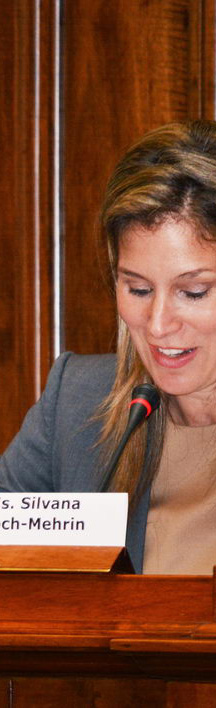
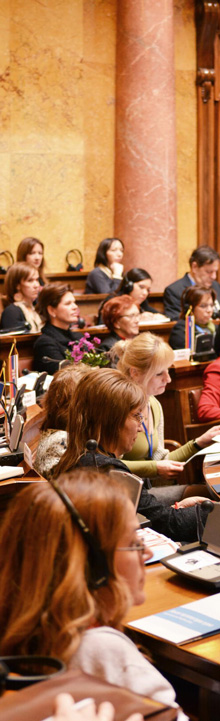


The conference was opened by, the National Assembly Speaker, who announced the adoption of the new Law on Gender Equality, expected in the Serbian Parliament by the end of 2018. The new piece of legislation envisages the greater representation of women in the National Assembly, in official delegation that would present Republic of Serbia at bilateral and multilateral level, as well as in the management board of the large systems.
Stelianа Nedera, Deputy Resident Representative spoke on behalf of the United nations Development Program (UNDP). She referred to a significance of women in the creation of better future, as well as in the areas of environmental protection and the preservation of the natural resources. She emphasized that the new UNDP Strategic Plan 2018-2021 foresees a greater focus on gender equality. Nedera noted that the institution and their systemic response are essential in the process of the to the prevention of the gender-based violence and that the parliament, as the supreme legislative body in the country, is one of the key partners in this process.
Ursula Laeubli, Director of the Swiss Cooperation Office in Serbia, pointed out that gender equality is one of the priority topics of Swiss bilateral cooperation both globally and in Serbia. Within the context of the 2030 UN Agenda, i.e., SDG No 5, “Achieve gender equality and empower all women and girls”, Switzerland in Serbia supports the empowerment of women entrepreneurship and the increasing employability of women, especially those from vulnerable groups. She stressed the Swiss support to the Women’s Parliamentary Network which plays a significant role in the creation of political life.
The conference, which gathered more than 450 members from 90 of local parliaments was formatted in three panels, of which the third one was organized through three working groups. The participants had the opportunity to discuss and suggest the next steps for increasing the women’s political participation in the areas related to the fulfillment of the SDGs, digitization and climate change.
The first panel, chaired by Stefana Miladinović, MP and the member of the Women’s Parliamentary Network, was dedicated to the effects that digitization process on gender equality in Serbia. Participants discussed about the benefits of the entire digitization process implemented by the Government of the Republic of Serbia, the positive consequences of the process to the Serbian citizens and the economy and the place of gender equality in this area. Jelena Ružičić, UNDP consultant and Tatjana Matić, State Secretary for Telecommunications, were the panelists. Secretary Matić stressed, among other things, that advanced digital skills and digital competences would be the essentials for future digitalization and that women should not be minorities in these future professions. If women don’t join to these digital trends, she noted, the entire civilization will be dragged backwards.
Within the second panel entitled “Climate Change and Gender Equality”, chaired by MPs Nada Lazić and Jasmina Karanac, participants discussed about direct and indirect consequences that climate change has on the global and national level leaves in the field of gender equality. The panelists were Ana Vuković, professor at the Faculty of Agriculture, University of Belgrade and Darinka Radivojević on behalf of the Ministry of Environmental Protection.
The third panel entitled “Sustainable Development Goals: Gender Equality and its Importance for Women in Serbia” was organized through three working groups with the following topics: “Discrimination against women in labor relations”, “Violence against women: implementation of the Law against family violence” and “Participation of women in political, economic and public life “. In the work of the first parliamentary working group, Brankica Jankovic, Commissioner for the Protection of Equality, and Gordana Stevanovic, Deputy Protector of Citizens, took part, while the moderator was Marija Janjuševič, MP and member of the Women’s Parliamentary Network.
Speakers at the second working group dealing with gender-based violence were Stana Pantelić, Head of Domestic Violence Prevention Department at the Ministry of Interior, Ivana Slavnić, Advisor in the Department for the Prevention of Domestic Violence at the Ministry of Justice, and Tatjana Stevanović, Deputy Prosecutor General of the Basic Public Prosecutor’s Office in Nis, while the moderator was Dubravka Filipovski, MP and the member of the Women’s Parliamentary Network. The working group was opened by Gordana Čomić, National Assembly Deputy Speaker, who referred to the significance and effects of the Law on the Prevention of Domestic Violence and the manner of its adoption. She said that this law was made with the efforts of the Women’s Parliamentary Network and is an example of a law that marks the fact that the deputies understand what is the general interest. He also pointed out that this law is one of the rare pieces of legislation whose implementation has been constantly monitored. The third peculiarity of this law is that it has been adopted thanks to the fact that all relevant actors understand the necessity of the adoption of this kind of legal act – that, as she stated, legalizes the framework that violence is unacceptable in the society.
The third working group was moderated by Nataša Mihjalović, President of the Women’s Parliamentary Network, while Aleksandra Tomić, MP, Slavica Đukić Dejanović, Minister without Portfolio in charge of implementing the SDGs, Sascha Müller, Head of the Governance Sector within the Swiss Cooperation Office, Stana Božović, State Secretary for Gender Equality of the Ministry of Labour, Employment, Veteran and Social Policy, Sanja Popović Pantić, President of the Association of Business Women in Serbia and Amel Deroua, a member of the National Assembly of Algeria, Vice-President of the Committee for Agriculture, Fishery and Environmental Protection and a member of the Finance Committee
Women’s Political Network of Montenegro was presented to the conference participants.
The Sixth Conference of the Women’s Parliamentary Network was organized as part of the project „Strengthening the Supervisory Role and the Public in the Work of the National Assembly“ funded by the Swiss Agency for Development and Cooperation (SDC) and implemented by the United Nations Development Program (UNDP). The OSCE Mission also provided support to the conference.