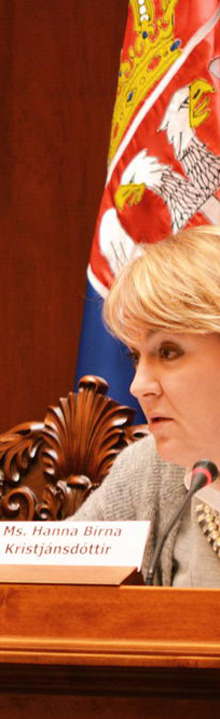

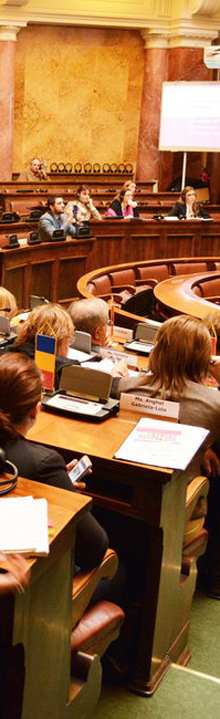

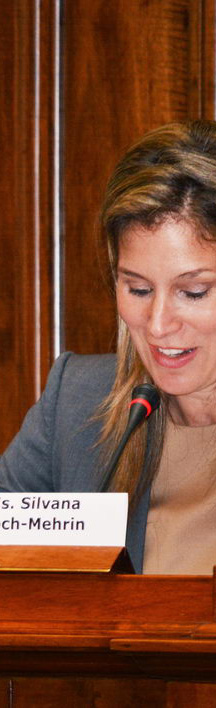
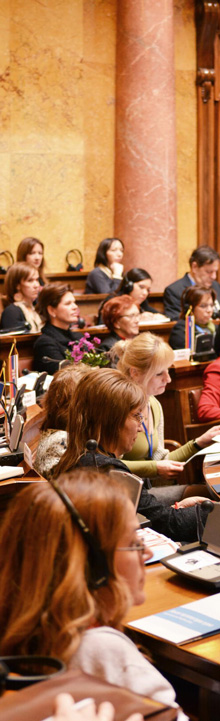

In her opening remarks Dubravka Filipovski, Serbian MP and President of the Foreign Affairs Committee, noted that the goal of the Republic of Serbia is the integration of the gender equality into all segments of life. She referred to the significant results achieved in the field of gender equality, among which are the implementation of the quota system for the less represented gender in the National and local assemblies since 2012, stressing that the National Assembly exceeded this percentage, since currently there is around 37% of less represented gender in the supreme legislative body, as well as the adoption of a new, more modern Law on Gender Equality, which is expected. MP Filipovski emphasized the importance of digitization for the overall progress of Serbia and the high place that this topic is taking on the agenda of the Serbian Government, mentioning the 850 000 Euro non-refundable funds invested in the development of women’s innovative entrepreneurship in 2018.
According to her, the following topics are considered as significant: the issue of the so-called „care economy “, since predominantly women are concerned with the child care eldercare, the broadest inclusion girls and middle age women in the digitization process, health, pension and social security in the digital age, as well as the new forms of contracting which brings technological development and the establishment of new relationships between employers and employees.
Margareta Eklund, the President of Freja Academy, referred to the overall development of Freya Forum as a unique story of voluntarism and movement in the Western Balkans and Turkey. According to her, the overall objective of the Freja Forum is to strengthen the social structure in order to develop non-profit organizations, with the aim of strengthening social development in the countries of the Western Balkans and Turkey. She highlighted the overall development of the Freja Forum since its establishment during the 1990s, when it was established as a platform for gathering women from various CSOs throughout the region in order to share knowledge and experience on democracy, equal opportunities and reconciliation.
The first projects were implemented in1997, with the aim of strengthening democracy and civil society. International mentoring began in 2003. The current form of the Freja Forum was created in 2006, as an independent platform for meetings and conversations. Eklund stressed that the mentoring program contributed to the establishment of close relationship between Bosnia and Herzegovina, Macedonia, Croatia and Serbia and also organizations from other participating countries.
Joakim Vern, deputy of the Swedish ambassador spoke on behalf of the Embassy of Sweden to the Republic of Serbia. He emphasized the responsibility of each country in promoting the opportunities and potentials of each individual in achieving his/her prosperity in life. He stressed the significance of the UN Resolution 1325 that defines the importance of women in peace processes, because without them, as he pointed out, long-lasting and sustainable peace in the world is not possible. In his words, the promotion of gender equality is a consequence of respecting the principles of democracy and social justice, and it is a prerequisite for sustainable growth, peace and security. The deputy ambassador also noted that increasing equality between women and men contributes to better health of the population, economy and education. In today’s turbulent times, he stated, every individual can contribute to the improvement of the world in which a modern man and women live, and the Freja Forum is a great example of this.
The Head of the sector for social inclusion and gender equality of the UNDP, Jelena Tadžić, referred to the importance of the Women’s Parliamentary Network, which, although informal initiative, strengthens gender equality in Serbia, contributing to the establishment of 50 parliamentary networks throughout the country, distributing and transferring its knowledge and experience at the regional level as well. She pointed out that in the previous period Serbia has made a lot of progress in the field of digitization and that it can be said it is a leader in the region. She noted that digital transformation is a huge opportunity for Serbia and that there are encouraging developments in that field, since the Serbian Government continues to make great efforts in the area through the stable business environment, technological development, entrepreneurship, information technology infrastructure and human resources.
In this process, the UNDP task is to provide assistance to the development and affirmation of Serbia. UNDP representative highlighted further support and promotion by UNDP to Serbia’s efforts to build a knowledge-based economy. In her words, UNDP has been dealing with gender equality from various angles for 15 years, and at this moment it is even more than it was in in the previous period, having in mind the position of the topic of gender equality in the new UNDP Strategic Plan. The opening ceremony was followed by a round table moderated by Sanja Popović Pantić. President of the Association of Business Women of Serbia.
The second day of the event was marked by three seminars and six workshops. The seminars dealt with the following topics: Digital Challenges for democracy and equal opportunities in EU, Europe and globally; Digital possibilities and challenges with robotization in society – threat or opportunity and Digital possibilities and challenges for democracy and equal opportunities in Social Media. Participants of the Forum worked intensively on the following topics of the workshops: Development of regional policies connected to EU accession Process; Young digital experts Home for All” (Report about the living situation for young people in Western Balkan and Sweden); A B C for social media concerning civil society (Introduction and development for CSO in digital world); Digital Nomads – the new way of working and Women, youth, equality and peace.
The third, closing day of the Forum was dedicated to the Freja Academy, organized as part of the Freja Forum, with the aim to improve the knowledge of individuals and CSOs through the lectures of prominent experts from various fields in order to strengthen their role and work as important factors of civil society. Within the Academy, three lectures on future communications and digital history were held in support of democracy, artificial intelligence and robotization and progress and redesign in cyber era.
As a platform for promoting and supporting the gender equality, equal opportunities, democracy, dialogue, diversity and entrepreneurship Freja Forum has been present in the Western Balkans since 1995. Representatives of various civil society organizations, academia, public and business sectors from Macedonia, Serbia, Bosnia and Herzegovina, Albania, Turkey, Sweden and EU participate in the Freya Forum. Freja Forum 2018 was supported by the National Assembly of the Republic of Serbia and the United Nations Development Program (UNDP). Co-organizers of the Forum were the Association of Business Women of Serbia, Freja Academy, Olof Palme International Center, Upsala Association of Tenants and Mihajlo Pupin Institute. In 2017 Freja Forum was nominated for the Nobel Peace Prize.